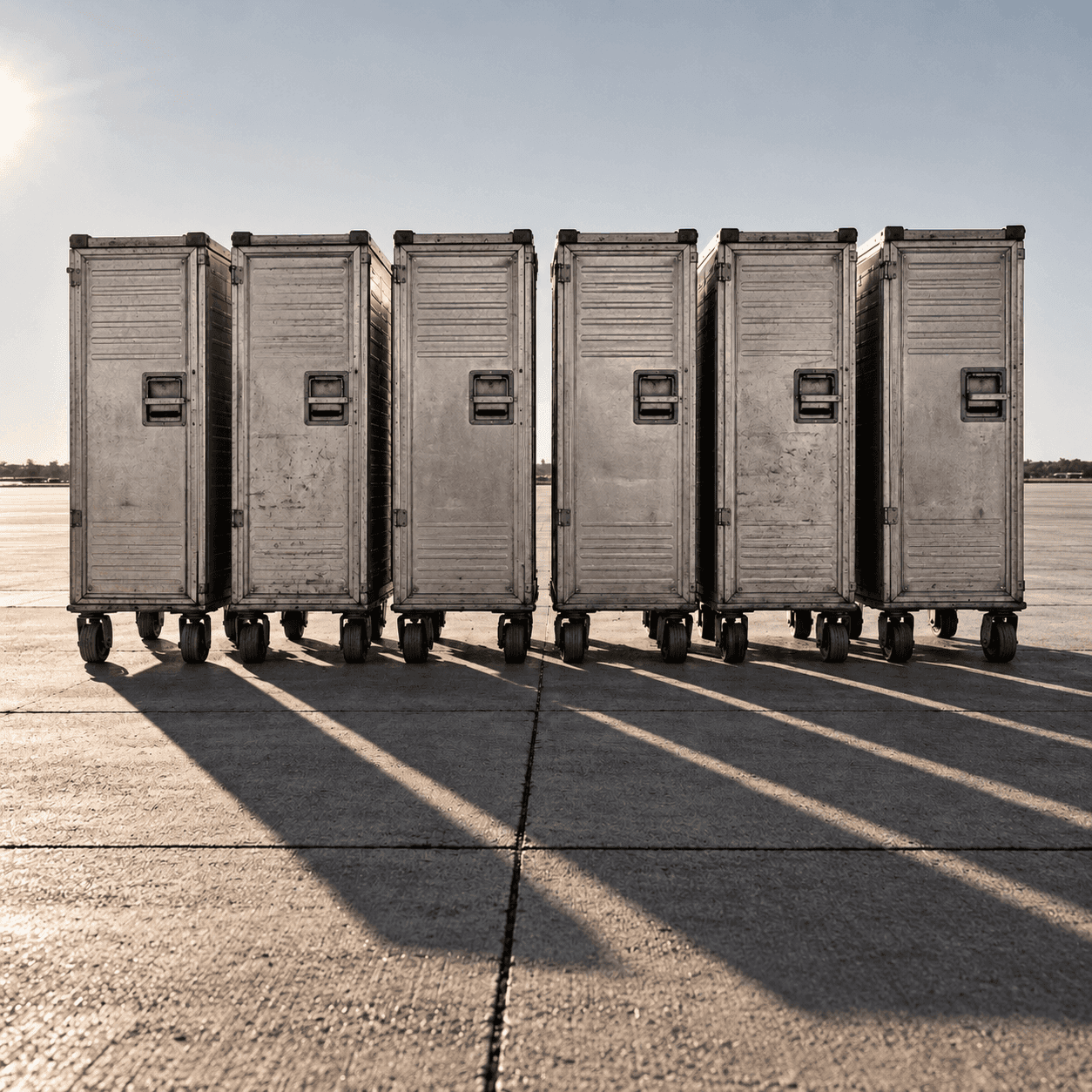
International Catering Waste
Some food waste is a quarantine problem.
Food waste from aircraft and vessels arriving from outside the country is regulated by the USDA, not treated as ordinary garbage. It has to be segregated, sealed, and destroyed at an approved facility, and when something goes wrong the liability lands on the operator rather than the hauler.
It isn't garbage. It's quarantine material.
Food scraps from a flight or vessel that originated outside the country can carry animal and plant pathogens that domestic agriculture has no exposure to. Foot and mouth disease and African swine fever are the ones that drive the rules. A single uncontrolled stream reaching open ground is the scenario the regulation exists to prevent.
That is why the requirement attaches to origin rather than content. The same tray of food is ordinary waste on a domestic flight and regulated material on an arriving international one.
Sealed from the aircraft to the furnace.
The material has to be separated at the point it comes off the aircraft or vessel, held in leak-proof sealed containers, transported without being combined into a general waste stream, and delivered to a facility approved to destroy it. Approved destruction means incineration or an equivalent sterilization method, not burial.
Every step generates a record, and those records have to be retained and produceable. The paperwork is not an afterthought to the process. It is the only evidence the process happened.
The failure is almost always a handoff.
The common failures are mundane. A hauler picks up who is not approved to handle the material. A sealed container gets tipped into a general compactor by someone covering a shift. Manifests go missing between the ground handler, the transporter, and the facility, so there is no way to show what happened to a load.
None of those are exotic, and all of them are the operator's problem. The regulation holds the generator responsible for where the material ends up, regardless of who was driving.
We own the chain, not just the pickup.
We confirm the receiving facility's approval is current rather than assumed, set up segregation at the point of generation so it survives a shift change, and hold the records so they exist when somebody asks for them.
The cost of doing this properly is modest. The cost of not being able to show you did is not.
Start with WMRS.
A person reads every one of these, not a queue.